
When starting a centrifugal pump, you need to pay attention to a lot of things. Should you close the outlet valve when starting a centrifugal pump?
The answer is that you need to close it!
1: Why should the outlet valve be closed when starting a centrifugal pump?
When the centrifugal water pump is started, there is no water in the outlet pipe of the pump, so there is no pipe resistance and lifting height resistance. After the centrifugal pump is started, the centrifugal pump head is very low and the flow rate is very large. At this time, the pump motor (shaft power) output is very large (according to the pump performance curve), which is easy to overload, which will damage the pump motor and line. Therefore, the outlet valve must be closed when starting to make the pump operate normally.
If an axial flow water pump is used, the situation is the opposite. It must be started with the valve open. At this time, the motor power is the minimum. Due to the lack of resistance in a short period of time, it will operate at a large flow rate, often causing pump vibration, noise, and even motor overload, which will burn the motor. Closing the outlet valve is equivalent to artificially setting the pipe resistance pressure. After the pump is operating normally, slowly start the valve to allow the pump to gradually work normally along its performance curve.
Before starting the centrifugal pump, two points must be ensured:
1) Fill the pump casing with water to form a vacuum;
2) The gate valve on the outlet pipe must be closed so that the pump does not form a flow, which can reduce the motor starting current and facilitate the smooth start of the pump. As the pump starts smoothly, the gate valve should be opened slowly and in time.
The centrifugal pump lifts the water by the vacuum suction formed by the centrifugal force of the impeller. Therefore, when starting the centrifugal pump, the outlet valve must be closed first and water must be filled. The water level must exceed the impeller part and the air in the centrifugal pump must be discharged before it can be started. After starting, a vacuum is formed around the impeller, sucking the water upward, and it can open automatically to lift the water. Therefore, the outlet valve must be closed first.
2. About centrifugal pump
A centrifugal pump is a vane pump that relies on the rotating impeller. During the rotation process, due to the interaction between the blades and the liquid, the blades transfer mechanical energy to the liquid, which increases the pressure of the liquid and achieves the purpose of conveying the liquid. The operation of a centrifugal pump has the following characteristics:
1)The head generated by a centrifugal pump at a certain speed has a limited value. The working point flow rate and shaft power depend on the conditions of the device system connected to the pump (position difference, pressure difference and pipeline loss). The head changes with the flow rate.
2) Stable operation, continuous delivery, no pulsation in flow and pressure.
3) Generally no self-priming ability, the pump needs to be filled with liquid or the pipeline needs to be evacuated before it can start working.
4) Centrifugal pumps are started with the valve of the discharge pipeline closed, and vortex pumps and axial flow pumps are started with the valve fully open to reduce starting power.
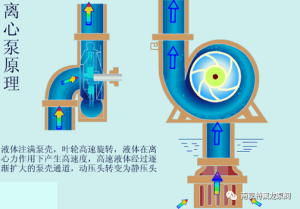
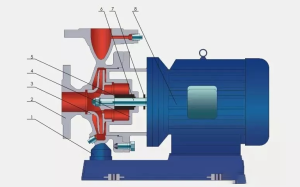
Before the pump is started, the pump casing is filled with the liquid to be transported; after starting, the impeller is driven by the shaft to rotate at high speed, and the liquid between the blades must also rotate with it. Under the action of centrifugal force, the liquid is thrown from the center of the impeller to the outer edge and gains energy, leaving the outer edge of the impeller at high speed and entering the volute pump casing.
In the volute, the liquid slows down due to the gradual expansion of the flow channel, and part of the kinetic energy is converted into static pressure energy, and finally flows into the discharge pipe at a higher pressure and is sent to the required place. When the liquid flows from the center of the impeller to the outer edge, a certain vacuum is formed in the center of the impeller. Since the pressure above the liquid surface in the storage tank is greater than the pressure at the pump inlet, the liquid is continuously pressed into the impeller. It can be seen that as long as the impeller keeps rotating, the liquid will be continuously sucked in and discharged.