
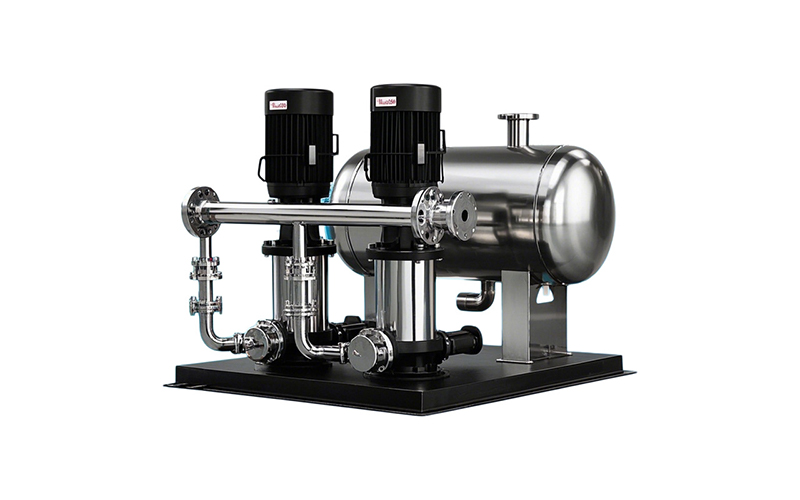
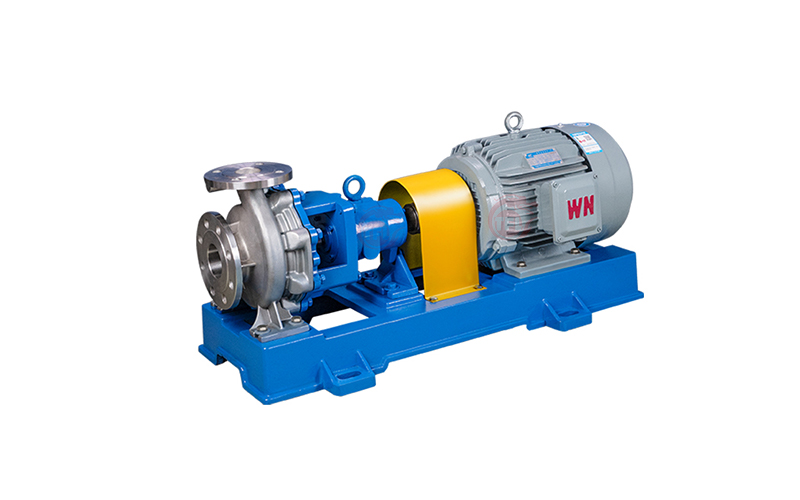
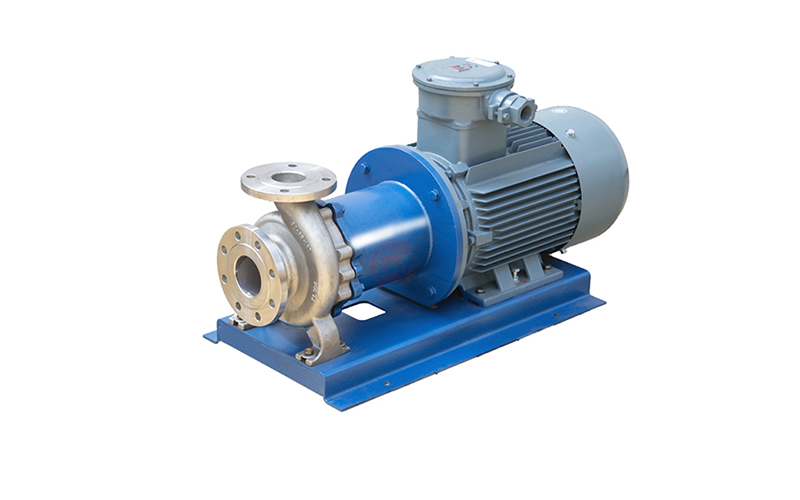
Introduction to magnetic pumps
Magnetic drive pumps are based on centrifugal pumps and use magnetic coupling to achieve contactless transmission of torque. They are new centrifugal chemical process pumps with no shaft seal, full seal, no leakage, corrosion resistance and no pollution.
Magnetic pumps are usually composed of motors, magnetic couplings and centrifugal pumps. Their main feature is that they use magnetic couplings to transmit power. When the motor drives the outer magnetic rotor of the magnetic coupling to rotate, the magnetic lines of force pass through the gap and the isolation sleeve and act on the inner magnetic rotor, so that the pump rotor rotates synchronously with the motor, and the torque is transmitted without mechanical contact. At the power input end of the pump shaft, since the liquid is enclosed in a stationary isolation sleeve, there is no dynamic seal, so there is no leakage at all. It is widely used in the production processes of chemical, petrochemical, metallurgical, pharmaceutical, printing and dyeing, paper making, electroplating and other enterprises to transport corrosive or non-polluting liquids with a relative density below 1.84, a viscosity similar to water, and no iron impurities and solid particles. It is especially suitable for the transportation of flammable, explosive, volatile liquids and toxic and precious media.
The magnetic pump is mainly composed of four parts.
1. The shell part is composed of the pump body, pump cover, etc., which bears the full working pressure of the pump.
2. The rotor part is divided into the rotating parts installed on the pump shaft and the rotating parts installed on the drive shaft.
The rotating parts installed on the pump shaft are composed of the impeller, bearing, thrust ring components, internal magnetic rotor components, etc. plus the drive shaft itself to form the rotor part in contact with the medium.
The rotating parts installed on the drive shaft are composed of the external magnetic rotor components, rolling bearings, drive shaft sleeves, etc. plus the drive shaft itself to form the rotor part in contact with the air.
3. The connection part is composed of the connecting frame, bearing box and other parts to form a static connection that plays a connecting and supporting role.
4. The transmission part The pump and the prime mover are connected by a diaphragm-type extended coupling component. When repairing, you only need to remove the middle diaphragm of the coupling to repair the pump.
Magnetic pump start-up and operation requirements
1. If the pump is installed below the liquid level, the gate valve of the suction pipeline should be opened before starting to fill the pump with liquid. If the pump is installed above the liquid level, the pump should be filled or vacuumed before starting to exhaust the air in the pump and fill the pump and suction pipe with liquid. Since the bearing lubrication of the pump is completed by the transported liquid, it is absolutely forbidden to run it dry.
2. Close the gate valves of the inlet and outlet pipelines. When starting, first start the motor and then close it after a few seconds to check and determine whether the rotation direction of the motor is consistent with the arrow direction marked on the pump body. Reversal is strictly prohibited. After determining that the rotation direction is correct, start again.
3. After the pump is started, slowly open the gate valve of the outlet pipeline. After the pump reaches normal operating state, adjust the outlet gate valve to the required operating range. When the discharge pipeline valve is closed, the pump operation time cannot exceed 1 min.
4. After the pump is started, if the flow rate and head of the pump do not rise to the rated value as the motor speed increases, the pump should be shut down immediately, and the pump should be carefully filled and exhausted to make the pump and the suction pipe completely filled with liquid before restarting.
5. When the motor speed reaches the rated speed, the flow rate and head of the pump also enter the rated value range or the required operating range, which is considered normal.