
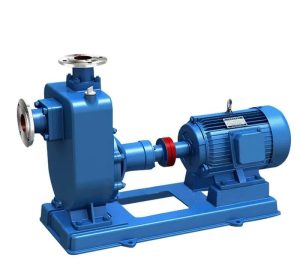
Self-priming centrifugal pumps use the principle of air pressure through the water storage chamber to achieve a priming life-long self-priming purpose, then affect the performance of self-priming centrifugal pumps is mainly reflected in what place? Mainly reflected in the following six aspects.
1. Determination of liquid storage volume and liquid storage height
The liquid storage volume refers to the volume of liquid that can be stored in the pump body after the pump is stopped, that is, the volume of the pump body below the lower point of the pump suction inlet. This volume is mainly part of the pressure chamber and the gas-liquid separation chamber. The liquid storage volume should not be less than half of the pump’s design flow rate in seconds [for example, the pump’s design flow rate, then the liquid storage volume should not be less than half of the pump’s design flow rate. If the liquid storage volume is too small [that is, there is too little liquid stored in the pump], it will cause self-priming. Over time, it may not even be able to self-prime; making the pump bulky. In addition to sufficient liquid storage volume, there must also be a certain liquid storage height. The liquid storage height is the height from the lower point of pump suction to the center of the impeller, which is usually taken to be approximately equal to the radius of the impeller.
2. Determination of the volume of the gas-liquid separation chamber and the height of the pump body outlet
Gas-liquid separation refers to the part outside the pressure chamber of the pump body. The larger the volume, the better the separation effect of gas and liquid, and the faster the separation. However, when the volume of the gas-liquid separation chamber is large enough, the effect will increase. It is not obvious. On the contrary, it will make the pump body bulky, so the gas-liquid separation chamber has a better volume value. According to existing experience, its value is equal to or slightly larger than the liquid storage volume. Under the condition of ensuring the capacity of the gas-liquid separation chamber, the pump The height from the body outlet to the center line of the impeller can be determined during drawing based on the liquid storage volume and the gas-liquid separation chamber volume.
3. Determination of liquid flow rate in the extrusion chamber
The flow rate of liquid in the discharge chamber of a centrifugal pump-type self-priming pump is lower than that of a general centrifugal pump, which is approximately equal to 80-90% of the flow rate of liquid in the discharge chamber of a general centrifugal pump.
4. Determination of the clearance between the septum tongue of the extrusion chamber and the impeller
For centrifugal self-priming pumps, the gap between the partition tongue and the impeller has a great influence on the self-priming performance. The smaller the gap between the partition tongue and the impeller in the upper pressure chamber, the shorter the self-priming time. This gap is usually taken from the external mixing; Mix and take. If it is designed as a double scroll chamber, the gap between the lower press chamber tongue and the impeller can usually be determined according to the method of determining the clearance between the press chamber tongue and the impeller of a general centrifugal pump, that is, the lower tongue is located on the base circle of the scroll chamber.
5. Turning of impeller rear cover plate
For external mixing centrifugal self-priming pumps, when the outer circumferential speed of the impeller is less than . The turning amount cannot be too large, otherwise it will significantly reduce the lift and efficiency of the pump. When the diameter of the impeller back cover is cut, the upper tongue is reinforced to prevent liquid with bubbles from circulating at the cut back cover and affecting the self-priming effect.
6. Area of return hole
For internally mixed centrifugal self-priming pumps, the area of the return hole has a great influence on the self-priming performance. A large area causes more liquid to return to the impeller inlet through the return hole, so the self-priming time is short, but the self-priming vacuum degree is large. Reduced; the smaller the return hole area is, the longer the self-priming time will be, and the larger the self-priming will be, the higher the vacuum height will be. Based on the above, when determining the return hole area, the requirements of self-priming time and self-priming height must be comprehensively considered.