
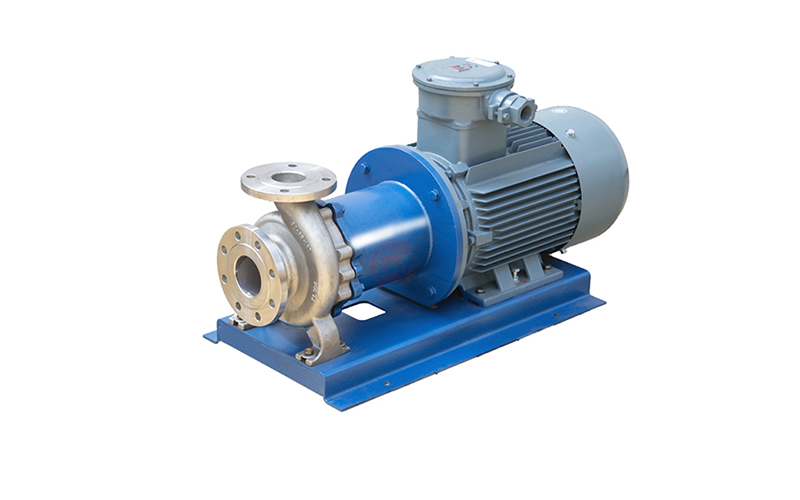
Compared with traditional sealed pumps, magnetic pumps have the advantages of less maintenance, no need for additional lubricating oil, no leakage, low vibration and noise, etc. However, due to its own characteristics, it is different from traditional centrifugal pumps in many aspects, so some measures and ways must be taken in terms of process, installation and operation to maintain its reliable and stable operation.
1. Structure: The magnetic lift pump is a horizontal, leak-free centrifugal pump with axial suction and radial discharge. The pump shaft is driven by a magnetic coupling and there is no shaft sealing device.
2. Bearings: The drive shaft of the magnetic pump is supported by a rolling bearing, which is lubricated by its own grease; the pump shaft is supported by a hydraulic sliding bearing.
3. Magnetic coupling: The magnetic block of the magnetic lift pump is made of high-quality rare earth permanent magnets, and its maximum irreversible temperature can reach 350-400, which fully maintains the reliability of the magnetic coupling. During normal operation, the magnetic coupling runs synchronously with the three-phase asynchronous motor with stable performance. In addition, the permanent magnet has high stability, which can prevent adverse effects when assembling and disassembling the rotor or when the pump works under a large transmission torque.
4. Lubrication of sliding bearings and cooling of magnetic couplings: The medium transported by the pump is lubricated and cooled without additional lubricating oil and cooling water systems.
5. Axial force balance: During operation, the axial force of the magnetic lift pump is automatically balanced by hydraulic power, and the push plate only bears the instantaneous axial thrust during starting and stopping.
What are the measures to keep the magnetic lift pump running smoothly?
1. The inlet and outlet pipelines of the magnetic lift pump should be supported to prevent additional loads from being transferred to the pump. The magnetic lift pump cannot be used as a stress point in the pipeline. The pipeline system should be kept to provide compensation measures for thermal expansion.
2. When the positive suction pressure head is low, the inlet pipeline should be as short as possible to prevent cavitation. The inlet pipeline should be of appropriate size to keep the fluid flow rate no more than 3m/s; when conveying easily vaporized fluids or liquefied gases, keep the flow rate no more than 1m/s.
3. A regulating valve should be installed on the outlet pipeline to adjust the flow and head of the pump. When using a longer outlet pipeline or two magnetic lift pumps in parallel, it is recommended to install an additional one-way check valve.