
Installation and Use of Mechanical Seals for Centrifugal Pumps
Mechanical seals are widely used in various types of centrifugal pumps. They are a type of sealing device with high precision, requiring specific conditions for both installation and use.
I. General Principles for Mechanical Seal Installation and Use:
- Understand the pump conditions: Determine the pump shaft’s speed and diameter; understand the equipment’s manufacturing precision and seal cavity dimensions. A comprehensive and balanced consideration should be given to the pump’s own service life and the equipment’s importance in the production process.
- Estimate the medium pressure: The pressure in the pump’s seal cavity is generally not the pump’s discharge pressure, but lower than it.
- Understand the sealing medium: Determine whether the medium is gaseous or liquid, and whether it contains particles and their condition. Understand the medium’s properties and temperature to facilitate proper seal selection and necessary cooling, flushing, and lubrication measures.
II. Technical Requirements for Mechanical Seal Installation and Use:
- The radial runout tolerance of the shaft or shaft sleeve at the mechanical seal installation location must meet requirements. The surface roughness of the shaft or shaft sleeve must comply with technical requirements, and the outer diameter size tolerance should be h6.
- The axial play of the drive shaft should not exceed 0.2mm.
- The face runout tolerance of the seal cavity end face relative to the shaft surface must comply with Table 2 (refer to original for Table 1 radial runout tolerance).
- The end faces of the shaft or shaft sleeve and the seal cavity must have chamfers.
- When the conveyed medium has high temperature, low temperature, contains abrasive particles, is flammable, explosive, or toxic, corresponding measures such as sealing, flushing, cooling, and filtration should be taken.
- For certain mechanically seals driven by springs, pay close attention to the spring’s rotation direction. The shaft rotation direction should cause the spring to wind tighter; otherwise, seal failure may occur. The spring rotation direction is determined as follows: Looking from the stationary ring towards the rotating ring, use a right-hand spring for clockwise shaft rotation; conversely, use a left-hand spring.
III. Installation Method for Centrifugal Pump Mechanical Seals:
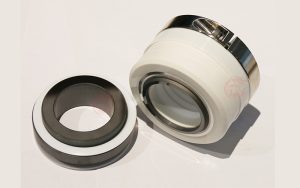
Mechanical seal components have very strict requirements regarding both manufacturing and installation precision. Improper installation can affect seal life and performance, and in severe cases, lead to rapid seal failure.
- Pre-installation Preparations and Precautions:① Check that the model and specification of the mechanical seal to be installed are correct and that no parts are missing.② Check if any components of the mechanical seal are damaged, especially the sealing faces of the rotating and stationary rings. If damage is found, repair or replace the parts. Clean all seal components with gasoline or kerosene, ensuring their surfaces are free of dust and foreign matter.
③ Check the shaft or shaft sleeve surface, the seal cavity inner wall, and the seal end cover inner surface for burrs, scratches, etc. If found, smooth and polish them. Clean with gasoline or kerosene, keeping them clean and free of dust and debris.
④ Do not use dirty cloth or gauze to wipe the surfaces of the rotating and stationary rings. Use clean, soft cloth or absorbent cotton.
⑤ Maintain cleanliness during assembly to prevent scratching or damaging the sealing faces of the rotating and stationary rings. To facilitate installation, apply engine oil to the shaft or shaft sleeve surface, and the contact surfaces between the gland and the seal rings to prevent dry friction during startup.
- Assembly Sequence:① Assembly of Stationary Seal Components:a. Insert the anti-rotation pin into the corresponding hole in the seal end cover.
b. Place the stationary ring seal ring onto the stationary ring, and install the stationary ring into the seal end cover, ensuring the anti-rotation pin engages with the groove in the stationary ring. When installing the gland, be careful not to let the stationary ring hit the shaft. Tighten the bolts evenly in several steps.
② Assembly of Rotating Seal Components: Assemble the rotating components of the mechanical seal onto the shaft in the correct sequence. If a shaft sleeve is used, first assemble the rotating components onto the shaft sleeve externally, then install the shaft sleeve with the seals onto the shaft.
③ Install the end cover onto the seal housing and tighten the screws evenly.
④ Rotate the shaft by hand to test if it turns easily. If it is hard to turn or feels stiff, check if the assembly dimensions are correct.
IV. Troubleshooting Mechanical Seal Operation in Centrifugal Pumps:
- Leakage from the start:① Check if the assembly quality meets technical requirements and if the spring compression meets specifications.② Check if the sealing faces of the rotating and stationary rings are damaged.
③ Check if the sealing faces are properly aligned.
- Sudden excessive leakage during operation: Stop the pump for inspection:① Check the wear condition and surface quality change of the rotating and stationary ring sealing faces. If damaged, repair or replace.② Check if the auxiliary seal rings (e.g., V-ring lip should face the pressure side) are correctly installed or damaged. Reinstall if incorrect; replace if damaged.
③ Check if solid impurities have entered the seal cavity, or if the drive seat is filled with debris affecting the axial float of the rotating ring and spring compensation.
④ Check if the set screws are loose, affecting the normal operation of the mechanical seal.
⑤ Check if the screws fixing the end cover are loose, causing misalignment of the seal end cover.
⑥ Check if the pump’s axial play and radial vibration exceed the specified technical requirements.
⑦ For assemblies with a shaft sleeve, check if the seal between the sleeve and shaft is damaged or incorrectly positioned.
⑧ Check if there is seal fluid circulation within the seal cavity, or if the mechanical seal is running dry.